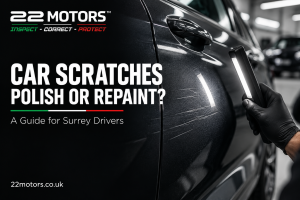
You notice a scratch on your car after a shopping trip. In the shade, it barely shows. Under direct light, it looks much worse. Before buying a scratch remover or booking paintwork, you want to know one thing: can car scratches be polished out?
Some light surface scratches can be improved or removed through suitable polishing. Deeper scratches that pass through the clear coat may need paint repair. The right approach depends on the depth of the damage and the condition of the surrounding finish. Automotive refinishing manufacturer 3M makes the same distinction between minor clear coat damage and scratches requiring more extensive repair.
For drivers looking for car scratch repairs in Surrey, a proper assessment helps avoid paying for unnecessary paintwork—or repeatedly polishing damage that needs a different repair.
Why similar looking scratches can need different repairs
A long scratch is not necessarily deeper than a short one. A faint mark across a door may affect only the surface, while a small chip can expose the layers underneath.
Many modern gloss paint finishes have a protective clear coat over the colour coat, with primer beneath. Damage can affect one layer or cut through several. Polishing works on the existing surface; it cannot replace missing colour or primer.
That is why a repairer needs to assess more than the length of the mark. Useful questions include:
- Is material sitting on top of the finish, or has paint been removed?
- Is the damage shallow or visibly chipped?
- Is there also a dent, crack or displaced panel?
- Has the area been repaired or repainted before?
- What result can reasonably be achieved with the proposed method?
A photograph can help start that discussion, but it may not provide enough detail to confirm the repair.
When polishing may be suitable
Polishing may be appropriate for fine surface defects, such as light scratches and swirl marks, where the finish is suitable for correction. Professional polishing products are designed for particular defects and paint systems; they are not universal solutions for every visible mark.
The important decision is whether the mark can be corrected without compromising the surrounding finish.
Rather than asking only, “Can you make it disappear?”, ask:
Can this be safely corrected by polishing, and what improvement should I expect?
This gives the repairer room to explain the limitations. In some cases, improving the appearance may be more appropriate than trying to remove every trace of a deeper defect.
What about paint transferred from another object
A scrape can leave material on the surface as well as damage underneath. Until the area has been appropriately cleaned and assessed, it can be difficult to separate the two.
Avoid assuming that removing the visible transferred material will reveal undamaged paint. Ask the workshop to assess the finish underneath before deciding whether further work is needed.
When a scratch may need repainting
If a scratch has removed colour or reached deeper layers, polishing alone will not restore the missing finish. The affected area may need preparation and refinishing.
Ask for an assessment if you can see chipped paint, a clearly damaged coating or an area that remains noticeably different after gentle cleaning.
There is no need to decide the paint process yourself. A useful estimate should explain:
- Which area is damaged.
- What preparation is required.
- Which panels will be refinished.
- Whether surrounding paintwork needs blending.
- Whether any related body damage must be repaired first.
22 MOTORS™ provides car scratch repair services covering scratches, scuffs and paintwork damage. The appropriate repair should be based on the condition of your vehicle rather than a generic scratch-removal promise.
Can you judge scratch depth at home
You can gather useful information, but a home check should not be treated as a diagnosis.
Park safely, inspect the area in good light and take clear photographs. Note whether the mark crosses more than one panel and whether there are any chips, dents or changes in panel alignment.
You may have seen advice about running a fingernail over a scratch. Even if a mark catches, that does not identify the exact paint layer affected or establish the correct repair method.
Similarly, a scratch becoming less visible when wet does not prove that it can be permanently polished away.
The most useful thing you can do is describe what you see accurately and let the repairer assess the finish.
Does a bumper scratch need the same treatment as a door scratch
Not always. The paint damage may look similar, but the underlying component and any related damage can differ.
For a bumper scrape, tell the bodyshop whether the bumper also appears cracked, loose or out of position. If you have noticed a warning message or a change in parking sensor behaviour after the impact, mention that too.
Ask the workshop to distinguish between the cosmetic repair and any additional inspection needed. A small visible scrape should not be used to assume either that everything behind it is damaged or that everything is unaffected.
Our bumper repair or replacement guide for Surrey drivers explains the questions to ask when the damage involves more than paintwork.
What if the scratch also includes a dent
A scratch and a dent are two aspects of the same damaged area. The panel’s shape and its finish both need to be considered.
Ask whether the proposed estimate covers both. For example, a price described simply as “scratch repair” may leave you unclear about how an accompanying dent will be handled.
If you are exploring repair options, our guide to car dent repair without repainting explains why paint condition matters when assessing a dent.
The best starting point is a complete assessment of the affected area, rather than choosing separate treatments from photographs.
Will the whole car need respraying
A scratch does not automatically mean that your whole car needs repainting. Ask the bodyshop to explain the proposed repair area and why it has been selected.
The area being refinished may be larger than the visible scratch. Preparation and colour blending can affect the scope of the work, so it is worth asking which panels are included.
A clear explanation should distinguish between:
- The panel that is physically damaged.
- The area being repaired and prepared.
- The paintwork involved in achieving a consistent finish.
Do not judge the scope solely by the size of the scratch. Equally, ask questions if an estimate includes work you do not understand.
What affects the cost of car scratch repair
There is no single car scratch repair cost that applies to every vehicle. Before comparing estimates, make sure they describe the same work.
Useful points to clarify include:
| Factor | What to ask |
| Damage assessed | Does the estimate cover every affected panel? |
| Repair method | Is polishing, paint repair or another process proposed? |
| Additional damage | Are dents, cracks or loose fittings included? |
| Paintwork | Which panels require refinishing or blending? |
| Inspection | Is this a photo-based estimate or a confirmed repair plan? |
| Total payable | Does the figure include VAT and any separate charges? |
A lower estimate may cover a smaller scope. A higher estimate should come with an understandable explanation of the additional work.
For a wider overview of repair options, read our car body repair guide for Surrey drivers.
What to avoid before the damage is assessed
It is tempting to keep trying different products when a mark will not disappear. Before doing that, consider whether you actually know what kind of damage you are treating.
Avoid using household abrasives, scraping at the mark or repeatedly working the same area without appropriate guidance. Follow the vehicle and product instructions, particularly if the finish is unusual or has already been repaired.
If you have applied a product, tell the bodyshop what you used. This gives the technician useful context and helps explain any change in the appearance of the area.
You do not need to hide an attempted repair. Accurate information makes the assessment more useful.
How to request a useful scratch repair estimate
Clear photographs help the workshop understand where the damage is and how far it extends.
Send:
- A wider view showing the affected side of the vehicle.
- A photograph of the complete damaged panel.
- A close-up showing the mark clearly.
- A view of any neighbouring panel affected by the same scrape.
- Your vehicle registration and a short description of what happened.
Mention any accompanying dent, loose trim or warning message. If the damage is difficult to photograph, say so rather than relying on an image that makes it look smaller.
Ask whether the workshop needs to see the vehicle before confirming the repair method, price and booking arrangements.
Questions to ask before booking
A few clear questions can make the repair process easier to understand:
- Can the mark be corrected by polishing, or is paintwork required?
- What result should I expect?
- Does the estimate include all the damage discussed?
- Could an inspection change the proposed work?
- How will additional work be explained and approved?
- What aftercare advice will I receive?
Keep a copy of the agreed scope. When collecting the car, ask the workshop to walk you through the repaired area and explain the aftercare requirements.
Frequently asked questions
Can all car scratches be polished out
No. Polishing is suitable for certain surface defects. Scratches that remove deeper layers of the finish may require paint repair. An assessment is needed to decide what is appropriate.
Can a white scratch be removed without painting
The colour of the mark alone does not establish its depth. Ask the repairer to determine whether it is transferred material, surface damage or damage through the finish.
Can a scratch remover fix missing paint
A polishing product cannot replace missing colour. If paint has been removed, ask a bodyshop about an appropriate repair rather than expecting polishing to rebuild the finish.
Does every scratch need a full panel respray
Not necessarily. The repair area depends on the damage and the refinishing requirements. Ask the workshop to explain the proposed scope before approving the work.
Can I get an estimate from photographs
Photographs can support an initial assessment. The repairer may still need to inspect the vehicle to confirm the condition of the paint and the most suitable method.
Can 22 MOTORS assess scratches and dents together
22 MOTORS™ offers scratch and body repair services. Include photographs of both the scratch and any accompanying dent when requesting an estimate so the team can review the complete affected area.
Get your car scratches assessed by 22 MOTORS
You do not need to know whether your car requires polishing or repainting before getting in touch. Start by showing the damage and explaining what happened.
For car scratch repairs in Surrey, request a free no-obligation estimate from 22 MOTORS™. Share your vehicle details and clear photographs, and ask the team whether an inspection is needed to confirm the repair.